Reader-supported: we may earn a commission when you buy through the links on this page, at no additional cost to you. Prices move constantly on Amazon — confirm the live price before you order.
Three hundred dollars is a strange ceiling. It is high enough to buy a real machine — not a gadget, a sealed tub that sprays hot water under pressure and pumps itself out — and low enough that the compromises are structural rather than cosmetic. Above the ceiling you buy certification, capacity and a support history. Below it you buy the wash, and pay for the rest in inconvenience.
We compared every portable dishwasher in our database listing under $300 and organised them by what each price step buys rather than by rank. Nobody shopping at $170 is weighing it against $290; they want to know whether the extra $120 changes anything they notice on a Tuesday night. Sometimes it does. Sometimes it buys a program list nobody uses.
There are three meaningful steps. Around $170 you get a working tank machine and nothing surplus. Around $250 you get a full-size tub, dual water sources and the first published decibel figures. Between $279 and $299 comes the interesting part of the shelf: the first ENERGY STAR certification, the first machines quoting real place settings instead of "30+ dishes", and the drying tricks that separate dry plates from damp ones. Skip to the table, or to what you give up.
How this page is put together
We compare published specifications, box contents, dimensions, certification and live pricing. We do not physically test these machines, we do not run a testing lab, and we do not publish ratings we cannot verify — Amazon's product data returns no rating or review information for any dishwasher here, so inventing one would be dishonest decoration.
Everything a manufacturer says about capacity, noise and water use here is a claim rather than a measurement, and we flag it as such.
Under $300, you are mostly buying the same box
Line the spec sheets up and something obvious appears. The HAVA measures 16.9 by 16.8 by 18.1 inches. The NOVETE measures 16.9 by 16.8 by 18.1 inches. The Hermitlux measures 16.85 by 16.73 by 18.23. The EUHOMY measures 16.83 by 16.73 by 18.03. These are not competing designs; they are the same contract-manufactured shell — roughly seventeen inches square, eighteen tall, five-litre tank, front door — sold under whichever brand ordered the container.
That is not a scandal; it is why the category exists at this price. But it changes how you shop: you are choosing between control boards, program lists, tank sizes, drying strategies and the odds the brand still exists when a door seal fails. It also explains why the listings shout. When the hardware is common, the copy does the differentiating, which is how one machine advertises "8 programs" where its dimensional twin advertises six and the difference is that one counts the drying fan and the rinse. Read the cycle names, not the number.
So pick the band that matches how much you need to wash, then choose inside it on the three things that genuinely vary: tank versus faucet, how the machine dries, and how tall it stands against your wall cabinets. If you have not measured that gap, do it now — our guide to apartments, dorms and RVs explains why the eighteen inches above your counter disqualifies more kitchens than price does.
The six, compared
Capacity figures are the manufacturer's claims, in the manufacturer's own units — which is part of the story. Prices are the ones we sourced and will have moved.
| Dishwasher | Best for | Water source | Claimed capacity | Drying | Price | |
|---|---|---|---|---|---|---|
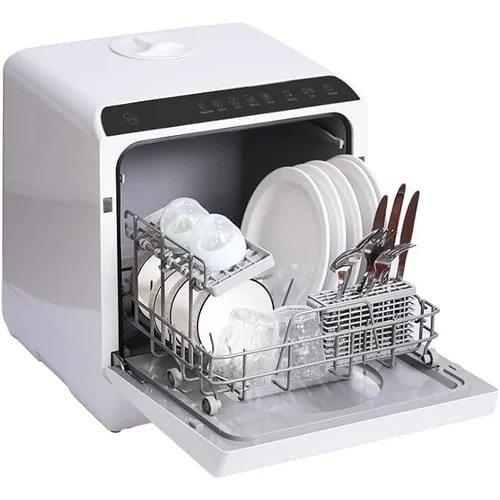 Canbo Tabletop Canbo Tabletop | Lowest sensible entry | Tank | 1–3 settings, plates to 10.5 in | Dry function | $189.99 | Price |
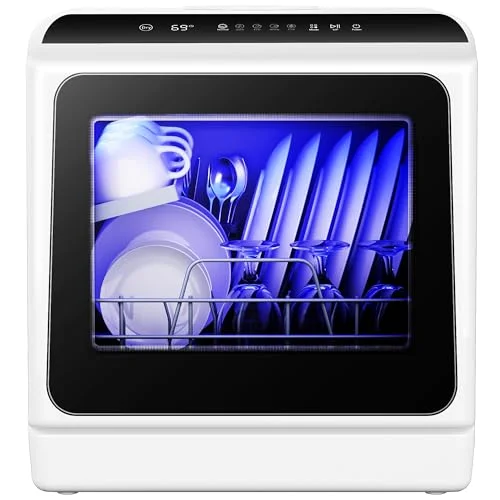 EUHOMY 40 dB EUHOMY 40 dB | Open-plan kitchens | 5 L tank or faucet | 30+ dishes, plates to 10.25 in | Residual heat | $249.99 | Price |
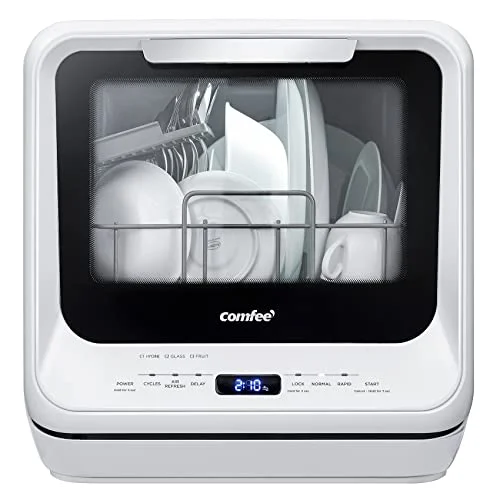 COMFEE' Minilite COMFEE' Minilite | Smallest counters | 5 L tank or faucet | Mini tub, 6 programs | Air Refresh | $249.92 | Price |
| COMFEE' 6-Place ENERGY STAR | Most machine under the ceiling | Faucet only | 6 settings, up to 70 pieces | Extra-dry function | $278.94 | Price |
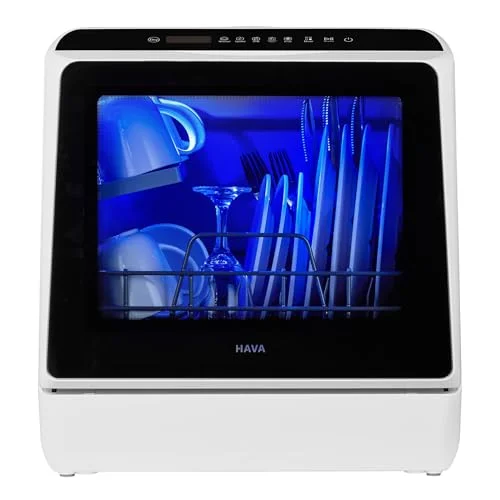 HAVA Countertop HAVA Countertop | Biggest plates in a tank machine | 5 L tank or faucet | 4 settings, dishes to 11 in | Dry mode | $289.00 | Price |
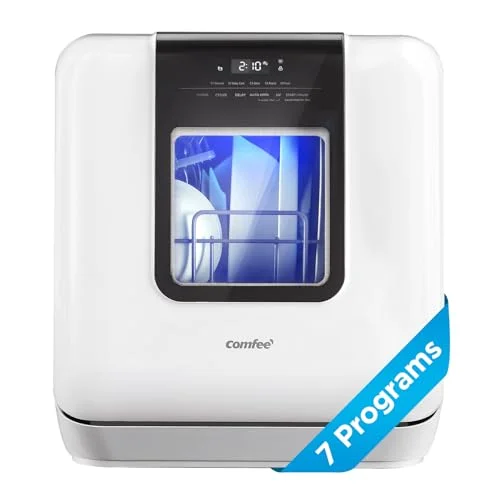 COMFEE' Miniplus COMFEE' Miniplus | Dry dishes without a heater | 6 L tank or faucet | Plates to 10.5 in | Auto-open door | $342.05 | Price |
Band one: around $170
A real wash and nothing surplus — but no room for a family meal.
Canbo Countertop Dishwasher with Built-in Water Tank
This is worth the entry price, rather than the $60 gadgets below it, because it has the parts that make a dishwasher a dishwasher. Two spray arms, upper and lower, instead of a single spinner that leaves a shadow across the top of the rack. A genuine built-in tank, so it runs from a jug and a wall socket with no adapter and no landlord conversation. Five programs — Normal, Quick, Eco, Baby Care and Fruit — with a Quick cycle the listing puts at 29 minutes. Canbo states one to three servings of tableware, the most honest capacity claim on this page precisely because it is the smallest. For one person, or a household that mainly wants hot water for baby bottles, that is enough. For two people cooking dinner, it is one pot short of useless.
The trade-offAn unfamiliar brand with a thin support history, and a noise figure the listing describes only as "very low" without publishing a number. Buy it as a first dishwasher or a bottle washer, not as the machine you keep for a decade.
One machine nearby is worth naming so you can rule it out: the Collier Kitchen countertop model at about $205, whose listing promises "powerful cleaning in a small size" and says nothing measurable — no dimensions, no capacity, no cycle names beyond a count of five. In a category built on shared hardware, the spec sheet is the only thing separating one seller from another, and its absence is itself the specification.
Band two: around $250
The $80 step buys a full-size tub in a countertop shell, dual water sources, and the first published noise figures.
EUHOMY 40 dB Countertop Dishwasher
Noise is the specification people ignore until the dishwasher is running six feet from the sofa, and it is what this machine leads with. EUHOMY rates it at 40 dB. Treat that as a manufacturer's claim with no third-party audit behind it — but it is still a signal, because most countertop machines that publish anything publish around 50 dB, and every 10 dB is roughly a doubling of perceived loudness. The rest is the band-two package done properly: a five-litre tank with a water-level indicator or a hose to the tap, dual spray arms, a Baby Care/Heavy cycle the listing puts at 167°F, and a Fast cycle finishing in 29 minutes. Note the listing's own arithmetic — the title advertises six programs and the bullets then name five.
The trade-offCapacity is quoted as "30+ dishes" rather than in place settings, which in this chassis works out at about four settings once you count bowls and glasses. Drying is residual heat, not an element, so plastics come out damp.
COMFEE' Minilite Countertop Dishwasher
The Minilite is what to buy when the honest answer is that you have room for a bread bin rather than a dishwasher. It is a mini tub instead of the seventeen-inch-square standard shell, runs entirely from its own five-litre tank, and has spray arms above and below rather than one — which matters more in a small tub, where a shadowed corner is a larger share of the load. Six programs cover Normal, Rapid, Hygiene, Fruit, Glass and Air Refresh, and Air Refresh is the one to care about: it circulates air afterwards to dry the machine as well as the dishes, and a small sealed dishwasher that sits unused between loads is exactly the appliance that develops a smell. One caution on the copy — COMFEE' quotes the Hygiene cycle at 192°F in the title and 162°F in the bullets. We use the bullet figure; the discrepancy tells you how much precision to expect.
The trade-offBand-two money for band-one capacity, in exchange for a smaller footprint. If your counter and cabinets can take the full-size shell, the same $250 buys a great deal more tub elsewhere in this band.
Two more machines sit in this band. EUHOMY's black-door model at about $249 differs mainly in drying: 60 minutes of hot air followed by what the listing calls up to 73 hours of automatic ventilation. If dishes sitting in a sealed tub until the weekend is your real use pattern, that matters more than a program count. At about $261 there is an eight-program EUHOMY measuring 15.74 by 16.14 by 18.11 inches — the narrowest full-capacity machine on the shelf. Its listing is also unusually candid, stating that the machine suits plates, bowls, cups, utensils and baby items, not bulky pots or baking trays. That is true of everything here. Only one of them says it.
Band three: $279 to $299
The last $40 under the ceiling is the most valuable money in this article: certification, real place settings, or a door that opens itself.
COMFEE' Countertop Dishwasher, 6 Place Settings, ENERGY STAR
This is the most machine anyone sells under $300, and the gap is not close. Six place settings against the four the standard tank chassis manages is not a 50 percent improvement in convenience; it is the difference between a dishwasher that absorbs a family dinner in one run and one that needs two — which is the difference between a machine you use and a machine you unplug. COMFEE' claims up to 70 pieces and plates to 10 inches, with eight cycles including Heavy, Baby-Care, ECO, Glass, Speed, a Mini-party program and a plain Rinse, plus extra drying. It is also the only machine under the ceiling here carrying ENERGY STAR, the one third-party verified specification in this category. At 17.2 inches tall it is shorter than the standard tank chassis, which helps if your wall cabinets are tight.
The trade-offNo tank. It connects to a faucet with an adapter, so if your kitchen has a pull-out sprayer tap it is simply not an option — read our hookup guide first. At 21.6 inches wide and 19.7 deep it also eats a serious stretch of worktop.
HAVA Countertop Dishwasher with Water Tank
HAVA quotes this one in place settings — four full ones — rather than in "dishes", and it is the tank machine we would choose if you cannot use a faucet adapter but still wash for a family. The rack takes dishes up to 11 inches loaded at an angle, which reads like a footnote until you own modern dinner plates and discover a 10-inch limit means the big ones never go in. Six programs cover Normal, Speed, Soft, Heavy/Baby Care, Fruit and a standalone Dry, and the spray arms use 14 water ports top and bottom. The dual supply is the reason to spend here rather than in band two: fill the tank from a jug and the machine needs only a socket, or clip on the included hose and stop thinking about refills. In a rental that flexibility is worth real money.
The trade-offFour place settings is a genuine ceiling, tank mode means refilling between loads, and drying is fan-and-residual-heat rather than an element. This is also the chassis with the most identical-twin competition, so check the live price before committing to the badge.
COMFEE' Miniplus with Auto-Open Drying
Almost nothing under $300 has a heated drying element, so the machines that dry best are the ones that get steam out of the tub. This one does it mechanically: at the end of the cycle the door pops open and lets moisture escape while the load is still hot enough to flash it off. It is the approach premium built-in dishwashers use, and it beats any fan at this price. The tank is a litre larger than the class standard, and the programs are the usual five — Normal, Rapid, Hygiene, Fruit, Glass — plus auto-open and a UV Hygiene mode. Our honest read on the UV: in a machine that already runs a hot Hygiene cycle, ultraviolet light in a sealed metal tub is a marketing feature more than a sanitation one. The door is the reason to buy this.
The trade-offAuto-open needs clearance, making this the worst choice under a low wall cabinet, and it vents warm damp air into the room every cycle. Capacity is quoted as one 10.5-inch plate at a time rather than in place settings, which tells you where it sits against the six-place model.
Two others crowd this band. The NOVETE at about $290 is the HAVA's dimensional twin — same 16.9 by 16.8 by 18.1 inches, same four place settings, same 167°F Baby Care cycle. It takes dishes up to 12 inches at an angle, the largest claim on this page, and its listing is the only one that itemises the load rather than rounding it up: four serving bowls, four cups, four small plates, four dinner plates and seven each of spoons, forks and knives. That should be the norm. Against it, there is no standalone Dry program; buy whichever is cheaper on the day. The Hermitlux at $299.99 sits exactly on the ceiling and claims five place settings from the same 16.85-by-16.73-by-18.23-inch shell — a claim we treat with caution, since identically sized machines claim four. It does add child lock, delay start and self-clean.
What you actually give up under $300
Certification, on almost everything. ENERGY STAR is the only independently verified specification in this category, and exactly one machine on our shortlist carries it under the ceiling. That does not make the others wasteful — a small tub washing five litres uses far less than a running tap — but every efficiency claim below $279 is the manufacturer marking its own homework.
Honest capacity units. "6 place settings" is a defined quantity: a plate, bowl, glass, cup, saucer and cutlery, six times over. "30+ dishes" is not a unit at all — a saucer is a dish and so is a dinner plate. When a machine sharing its exact external dimensions with a four-setting model advertises "30+ dishes" instead, the vaguer number is doing work. Convert to place settings before comparing, and where a listing refuses to, assume the lower figure.
Real drying. None of these has a heated drying element. They dry with residual heat, a ventilation fan, a long air cycle, or a door that opens itself — roughly in that order of effectiveness. Glass and ceramic will mostly be dry; plastic will be wet every time, regardless of price. Rinse aid is the cheapest upgrade any of them can take.
Decibel figures you can rely on. Where a number is published at all it is a manufacturer's claim, measured in the manufacturer's own conditions with no third-party audit. Two machines claiming 40 dB are not necessarily equally quiet.
Brand permanence. A countertop dishwasher is a pump, a heater, a door seal and a control board — all wear items — and several of these names did not exist five years ago. COMFEE' is Midea's value badge, with a real parts network behind it; the others are marketing entities of varying permanence sitting on shared hardware. Factor that into the gap between $250 and $290 rather than treating support as free.
The false economies
A machine too small to hold a meal. This is the expensive mistake. A dishwasher earns its counter space by absorbing the entire aftermath of dinner in one unattended run. A tub that takes half of it does not remove a chore, it splits one: the machine cycle, plus the pans and big plates and whatever did not fit — which is still you at the sink with a sponge. The pattern is predictable: two runs a night for a fortnight, then one, then it becomes a drying rack, then it is unplugged on the floor of a closet. If your household regularly generates more than four place settings at dinner, the smallest machine worth considering is the six-place model. Our piece on whether portable dishwashers are worth it works through that math.
The UV "steriliser" box. Below about $150 the results fill with cabinets that hold a few plates under an ultraviolet lamp with a warm-air fan and call themselves dishwashers. They are not. No pump, no spray arm, no detergent, no mechanical action — nothing is removed, only irradiated in place. A dishwasher cleans by throwing hot detergent solution at dishes under pressure. If a listing does not name a spray arm and a wash cycle, it is a warming drawer with a lamp in it.
Buying a tank you will never fill, or a fitting you cannot use. With a straight tap and a removable aerator, faucet mode is strictly better — no refilling, no five-litre limit — and paying a premium for a tank buys a feature you will use twice. With a pull-out sprayer the reverse holds, and a faucet-only machine like the six-place COMFEE' is unusable at any price. Establish which kitchen you have before you shortlist, not after.
When it is worth stepping just over $300
The ceiling is arbitrary and the shelf just above it is unusually good value. At about $310 the black six-place COMFEE' is the same ENERGY STAR machine as our band-three pick in a different finish, so the practical price of six place settings runs from $279 to $310 depending on colour and the day. Also at about $310, an AIRMSEN claims 40-plus items and 12-inch plates from a five-litre tank, with a claimed 72 hours of ventilated storage after the wash.
Two justify crossing the line outright. The HAVA with an integrated water softener at about $329 is the more interesting: hard water films glasses, coats the heating element and shortens the life of a small machine, and this is the only countertop model we have found that lets you set a softener level to match local water hardness. If your utility's hardness report is high, that single specification does more for your results than any program list under $300. The Midea six-place at about $340 is the COMFEE' format with delay start from 1 to 24 hours and a Power Wash, sold by the parent company of the badge.
Our rule of thumb: choosing between $250 and $290, spend the $40 — it buys capacity or drying, and you notice both daily. Choosing between $290 and $340, spend only for a specification you can name, like the softener or the delay start. And if the choice is between a $170 machine and nothing, the $170 machine is a rational way to find out whether the category suits you. For the wider view, the main portable dishwasher guide covers every price, and the countertop versus 18-inch comparison explains the fork in the road that decides everything else.
Frequently asked questions
Is a countertop dishwasher under $300 actually worth buying?
Yes, if the machine is large enough for the way you cook. Under $300 you get the same washing mechanism a full-size dishwasher uses: hot water sprayed under pressure with detergent, hotter and more thorough than hands can manage. What you do not get is capacity, a heated drying element, or in most cases an ENERGY STAR certification. The buying mistake is not the price, it is choosing a tub too small to absorb one meal, because a machine that needs two runs per dinner stops being used.
How many dishes does a $250 countertop dishwasher really hold?
Most machines in that band quote a claimed 30-plus dishes, which is not a defined unit. Models sharing the same external dimensions that quote place settings instead state four, so four place settings is the realistic figure: roughly four dinner plates, four bowls, four cups and the cutlery. Plate diameter is the other limit, with most tubs capping out between 10 and 12 inches, and dishes usually have to be loaded at an angle to reach the upper figure.
Do any countertop dishwashers under $300 have ENERGY STAR certification?
Very few. On our shortlist the six-place COMFEE' at about $279 is the only machine under the ceiling carrying it, and certification becomes common only above $300. ENERGY STAR matters here mostly because it is the one specification verified by someone other than the manufacturer — capacity, noise and water-saving figures on these listings are all self-reported claims.
Will dishes come out dry in a cheap countertop dishwasher?
Glass and ceramic mostly will; plastic will not. None of these machines has a heated drying element, so they rely on residual heat, a ventilation fan, a long air cycle, or a door that opens automatically at the end of the wash to let steam escape. The auto-open approach dries best, ventilation modes come second, and using rinse aid makes a bigger difference at this price than any program setting.
Keep reading
Countertop or 18-inch on wheels?
The split that decides capacity, price and whether the machine fits your kitchen at all. Read →
How-toHow to hook one up, step by step
Adapters, aerator threads, drain hoses and the taps that simply will not work. Read →
MaintenanceCleaning and descaling, so it lasts
The filter nobody knows about, and the schedule that decides whether you reach year five. Read →