How to hook up a portable dishwasher, faucet or tank.
The machine is rarely the problem. The tap is. Five minutes with a wrench-free aerator check tells you whether the adapter in the box will fit your kitchen — and that is the check almost nobody does before ordering.
By Ilane Tall · Updated August 13, 2026 · Research-based.
Reader-supported: some links on this page go to Amazon, and we may earn a commission if you buy, at no extra cost to you. It never changes what we recommend.
A countertop dishwasher is one of the few appliances you can unbox and be using inside twenty minutes. It is also one of the few that gets repacked and shipped back the same evening, and the reason is almost never the machine. It is the faucet: the adapter in the box will not thread onto the tap, no version of it will, and you find this out with a wet counter and a half-unpacked carton.
It is avoidable: the check takes five minutes and no tools, and a whole class of these machines — the tank models — exists for exactly the kitchens where a faucet connection is impossible. This guide does the check first, then walks the hookup: adapter, coupler, drain hose, power, first cycle and leak test.
The three numbers that decide it
55/64‑27the common US female aerator thread
22 mmthe metric equivalent on imported taps
5 Ltypical tank, if your tap won't take an adapter at all
If the first two mean nothing after you've unscrewed your aerator, the third is your answer.
Start at the sink, not at the dishwasher
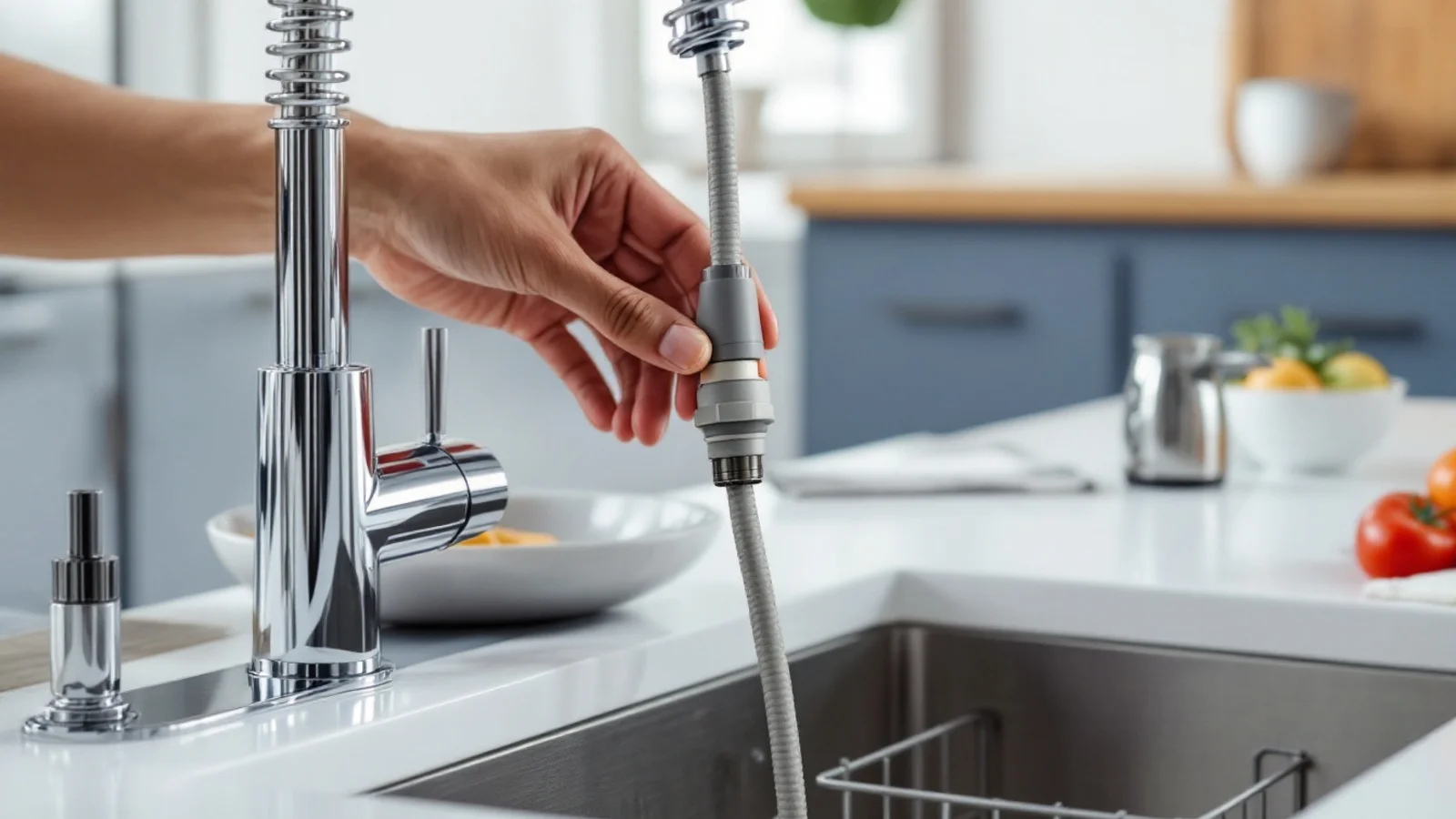
Look under the end of your kitchen spout. The small housing screwed into the tip — the one with the mesh screen that turns the stream into a soft column — is the aerator. Every faucet-connect portable dishwasher attaches where it sits: the aerator comes off, an adapter goes on in its place, and the quick-connect coupler clips onto the adapter. So the whole question is whether your aerator unscrews, and what is underneath it.
Getting it off. Turn it counterclockwise as you look up at it from below. Most come loose by hand, and a rubber jar-opener gives far more purchase than bare fingers; if it needs pliers, wrap the jaws in cloth, because chrome scars permanently. If mineral scale has welded it in place, an hour with a bag of white vinegar tied around the spout tip usually frees it.
What's underneath. Either the threads are cut into the outside of the spout — male, or external — or recessed up inside it, which is female or internal. Adapters come in both flavours, and the one in your box may fit only one.
The sizes. The two threads you'll meet on a US kitchen tap are 15/16‑27 male and 55/64‑27 female; imported taps use the metric pair, M24 × 1 and M22 × 1, which is where the "22 mm" in adapter listings comes from. The pitches are close enough that people cross-thread them and then wonder why the joint weeps.
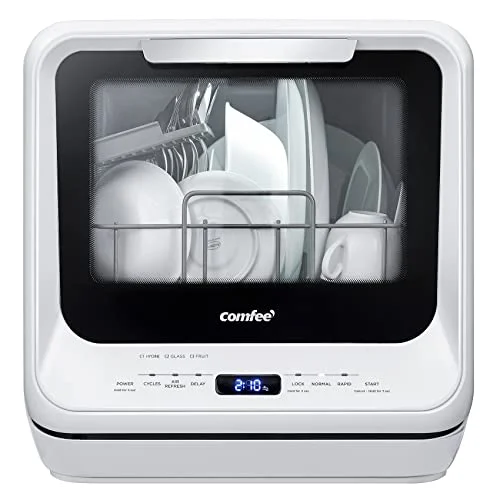
Manufacturers describe this unhelpfully. EUHOMY's 8-program tank model says to connect the included hose to a "G3/4-inch faucet" and to buy an adapter separately if your faucet size differs — the manufacturer telling you in advance that the box may not be enough. Treat any listing that says "suitable adaptor needed" the same way; the COMFEE' 6-place countertop machine uses that phrase in its installation bullet.
The shortcut that always worksTake the aerator itself to a hardware store. Every plumbing aisle has a rack of adapters, and matching a physical part beats measuring a thread pitch by eye.
One more spec worth reading: water pressure. COMFEE's Minilite family lists a working range of 0.04 to 1.0 MPa, roughly 6 to 145 psi. Municipal supply sits inside that; a well with a tired pressure tank or a gravity-fed RV system may not, and a machine below its minimum inlet pressure simply refuses to fill.
The taps that can't be adapted, and what to do instead
Some faucets will never take a dishwasher adapter — not with the right part, not with tape, not with force. Knowing which category yours falls into before you order is the most valuable thing on this page.
Your faucet
Will an adapter fit?
What to do
Straight spout, aerator unscrews
Yes, with the matching thread
Faucet-connect model is fine
Pull-down or pull-out sprayer
No
Buy a tank model
Touchless / sensor tap
Effectively no
Buy a tank model
Designer tap with a hidden or press-fit aerator
Usually no
Tank model
Wall-mounted or very low spout
Thread may fit, clearance won't
Tank model or an 18-inch machine on wheels
Deep farmhouse sink, tap far from the counter
Thread fits, reach may not
Measure the run first
Pull-down and pull-out sprayer faucets are the big one, because they are now the American default. The spout ends in a spray head on a retractable hose, and what looks like an aerator is moulded into that head as part of a proprietary assembly. There is no standard thread to attach to.
Touchless faucets fail differently: they close on a sensor and a timer, and a fill needs the tap held open through the cycle. Designer and wall-mounted taps vary — some hide the aerator behind a press-fit ring with no thread at all. If you can't see standard threads with the aerator out, stop looking for a better adapter: what you want is a machine that carries its own water.
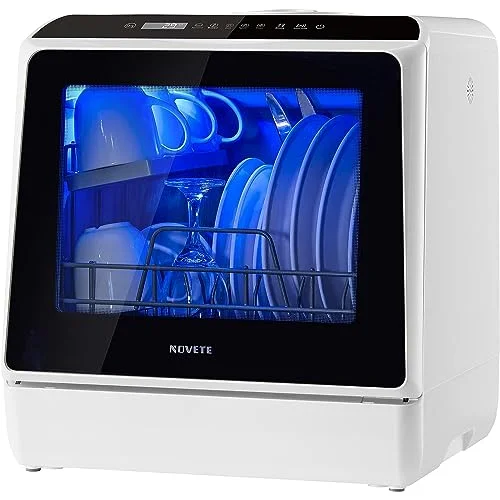
NOVETE Portable Countertop Dishwasher
Runs either way: a 5 L built-in tank you fill by hand, or the supplied inlet hose to a faucet. An automatic water-level indicator tells you when the correct level is reached. Four place settings.
Sold on the premise that no hookup is needed at all: fill the tank, plug it in, run it. Six programs including a Hygiene cycle at 162 °F, dual 360° spray arms, and an Air Refresh mode that keeps the tub from going stale.
About $250·tank only, no adapter needed·Check price →
The hedge worth knowing: most current countertop machines do both, and a model with a tank and an inlet hose costs no more than a faucet-only one. If you're still choosing a class, our countertop versus 18-inch comparison covers capacity and floor space, and the apartment, dorm and RV guide covers the room-shaped constraints that narrow the shortlist before specs do.
The hookup, step by step
What follows is the general procedure for a countertop machine connecting to a kitchen faucet. Your manual is the authority for your model, and where the two disagree, the manual wins.
1
Position the machine and check the clearance above it
A flat, level surface strong enough for a machine holding several litres of water, within reach of the sink — hoses here run a few feet, not across the kitchen. Then look up. These machines are 17 to 18 inches tall and need room for the door or lid to open: Hermitlux specifies at least 20.08 inches between counter and wall cabinet for its 5-place machine, and standard US wall cabinets sit around 18 inches up. This disqualifies more kitchens than price does.
2
Unscrew the aerator and keep it
Counterclockwise as you look up at it. Put it and its rubber washer in a zip bag with the dishwasher's paperwork: a lost aerator means a splashing faucet until you buy a replacement.
3
Thread the adapter on, hand tight, washer seated
Start it by hand. If it binds in the first turn, back it off completely and start again rather than forcing it — cross-threading brass or plastic ruins both parts. Check that the rubber washer sits flat inside the adapter, because that washer, not the thread, is what makes the seal.
Why hand tight is rightExtra torque doesn't improve a washer seal; it distorts the washer, and on a plastic collar it cracks the part. PTFE tape belongs on tapered pipe threads, not here.
4
Connect the inlet hose and seat the quick-connect coupler
Hand-tighten the inlet hose to the machine first, then take the coupler to the adapter. Quick-connects work by pulling back a spring-loaded collar, pushing the coupler fully home, and releasing the collar so it snaps forward and locks: the tell is a click and a coupler that won't pull off when you tug it. GE's Profile countertop dishwasher ships with what the trade calls a unicouple, and offers three installations — countertop, built-in or under-sink — so the faucet connection can be temporary.
5
Hook the drain hose over the sink edge and secure it
Over the rim of the basin, end hanging free above any standing water. Use the supplied clip, and if the hose still has coil memory from the packaging, tie or clamp it so it cannot flick out when the pump kicks in.
6
Plug into a grounded 120 V outlet
Straight into a properly grounded three-prong wall outlet, not an extension cord or a multi-way adapter. The power section below has the reasoning.
7
Open the tap, then run a hot cycle with nothing inside
Turn the faucet on slowly and watch the joint for a moment. Check your manual for the maximum inlet temperature it accepts — these machines heat their own water, so a scalding feed is neither needed nor always permitted. Then run one full hot cycle empty, no dishes, little or no detergent: it flushes manufacturing residue out of the tub and hoses, wets the seals, and gives you a controlled first fill to watch. COMFEE' also notes that its dishwashers are factory compared before shipping, so water inside a new machine is normal.
8
Do the leak check while that first cycle runs
Dry paper towel under the adapter and the machine's inlet fitting, and stay in the room for the fill and the first drain. A slow drip only announces itself once it has found the underside of a cabinet.
The drain hose, properly
There is no plumbing on the waste side of a portable dishwasher — no standpipe, no trap, no connection under the sink. A small pump pushes dirty water out through a hose that hangs over the edge of your sink. Simple, and easy to get wrong in three ways.
Height. The machine has to sit level with or above the point where the hose discharges. These pumps move water a short distance across and slightly up; they don't lift it from a low table into a high sink. Put the dishwasher on a chair beside a 36-inch counter and the pump fights gravity for the whole drain phase: the cycle ends with water still in the tub, and dirty water standing in a sealed tub is where the smell comes from — the problem we work through in the cleaning and descaling guide.
The free end. The hose end must hang in air above the water line, not lie in the basin. An end sitting in standing water can siphon that water back into the tub as the machine cools — the same physics as a fuel siphon. That's why the instruction is always to hook the hose over the rim, and why a sink full of soaking pans is not a drain point.
The run in between. No kinks, no tight coils, no long extension: every loop above the machine is water the pump has to lift and water that runs back when it stops. And expect your sink to be partly occupied for the length of the cycle — fine at 9 p.m., annoying at breakfast. If it has to stay clear, an 18-inch machine on wheels is the better shape of solution.
Tank mode, step by step
Tank mode is why this category works in kitchens that were written off. No adapter, no thread, no faucet: you pour water in and the machine uses it. Five litres is the standard tank here — about 1.32 gallons — and one fill is one cycle.
1
Set the machine level and get the drain hose in place first
Level matters more here, because the sensor is measuring a small fixed volume that isn't being topped up. And yes, the drain hose still goes over the sink edge: a tank feeds the wash, it does nothing about the waste.
2
Fill through the port with plain cold tap water
Most machines here ship with a funnel or filling guide — COMFEE' includes one with the Minilite — and pouring straight from a jug is how water ends up where it shouldn't be. Ordinary cold tap water unless your manual says otherwise, and don't shortcut the heating cycle with a kettle.
3
Stop when the water-level indicator says stop
This is the part first-time users ignore. NOVETE describes an automatic water-level indicator that tells you when the correct level is reached, and EUHOMY's tank models have the same. Overfilling doesn't wash better — it puts water where the machine expects air, which is one of the ways water gets onto your counter.
4
Detergent in the dispenser, never in the tank
Powder or gel dishwasher detergent, in the dispenser cup, at the small dose these tubs are designed for. Never regular liquid dish soap: COMFEE' states outright that standard dishwasher powders or detergents must be used because liquid dish soap will cause problems. It foams, the foam has nowhere to go, and it pushes out past the door seal. Pods disappoint here too, since a short low-volume cycle often doesn't dissolve one fully.
5
Close it, choose a program, and let one tank be one cycle
Five litres is the whole water budget for the wash and the rinses, so check the level before restarting an interrupted cycle.
What not to put in a tank: no liquid dish soap, no bleach, no boiling water, no vinegar as an improvised descaler unless your manual endorses it, no dishwasher salt unless the machine has a softener compartment. The tank is a plain reservoir feeding a pump, and anything corrosive or foaming goes straight through parts you cannot replace.
Power, and why the manual is so insistent about the outlet
This section is general information and a summary of what manufacturers put in their manuals, not electrical advice: anything involving the outlet itself — a loose receptacle, a missing ground, a circuit you're unsure about — belongs to a licensed electrician.
These machines run on ordinary US household power: 120 V, 60 Hz, into a properly grounded three-prong outlet. What makes them different from a toaster is duration. A portable dishwasher heats its own water — Hermitlux, EUHOMY and COMFEE' all quote cycles between roughly 162 and 167 °F — and that element draws meaningful current through much of a cycle that can run over an hour.
Hence the standing instruction in these manuals not to use extension cords, multi-outlet adapters or power strips: a long or thin cord adds resistance, resistance under sustained load makes heat, and a warm cord coiled behind a counter is a bad outcome. The same logic applies to sharing a kitchen circuit — if the dishwasher, the kettle and the microwave all heat at once, the breaker is doing its job when it trips. Outlets near a sink are also commonly GFCI-protected, and a GFCI that trips is telling you something: find out why rather than running a cord to an unprotected outlet.
The five-minute leak check
Three moments in a cycle reveal a leak, and they are not the same moment.
When the tap opens, pressure reaches the adapter and coupler. A drip here is almost always the rubber washer: missing, doubled up because the aerator's own washer stayed in the spout, pinched, or cross-threaded. Shut the tap, take it apart, look at the washer, reassemble by hand.
When the machine fills, the inlet hose and the machine's fitting come under pressure. Check where the hose meets the machine: hand tight and square, and if it seeps, back it off and re-seat rather than reefing on it.
When the machine drains, the pump runs and the hose stiffens and moves. This is when a badly secured drain hose jumps out of the sink — not a leak so much as a small flood with a warning label on it.
Water on the counter that isn't at any of those joints usually means a bunched door gasket, an overfilled tank, or foam from the wrong detergent.
How we know what we know here
The procedure above is standard, widely documented practice, and every model-specific detail — tank volumes, thread callouts, temperatures, clearances, what ships in the box — comes from the manufacturers' published specifications.
To be straightforward about our limits: we compare specifications and prices, we do not run a testing lab, and we do not publish ratings we cannot verify. You will not find a star rating anywhere on this site, because no rating data we could stand behind exists for these machines.
Disconnecting and storing between uses
Most people connect and disconnect a countertop machine regularly, so it's worth having a routine. Shut the tap first, always: the coupler is holding back line pressure while the faucet is open, and releasing a pressurised quick-connect is how you wash the ceiling. With the water off, pull the collar back, remove the coupler, and let the hose drain into the sink before you coil it. Then put your aerator back — fifteen seconds, and the difference between a normal faucet and one that sprays sideways.
Lift the drain hose out of the sink so residual water empties, and leave the door ajar or run the machine's ventilation mode: a sealed damp tub develops a smell within days, which is what COMFEE's Air Refresh and EUHOMY's 73 hours of automatic ventilation exist to solve. Empty the tank if the machine will sit unused, and if it is going into a garage or an RV over winter, drain it per the manual — water left in a pump housing or valve freezes, expands and cracks parts that are not sold separately. Keep the adapter, coupler and aerator in one bag with the machine: the second most common reason a portable dishwasher never gets used again is that nobody can find the adapter.
Troubleshooting the four things that go wrong
The adapter drips or sprays at the faucet
Start with the washer, the cause four times in five: missing, stacked two deep, crooked, or torn by over-tightening. Take the joint apart, seat one flat washer, hand-tighten. If it still weeps, look at the threads — a cross-thread leaves a visible gap on one side and never seals. A metric adapter on an imperial tap will bite for a turn and then leak forever; that's a wrong-part problem, and thread tape won't rescue a joint that seals on a washer.
The machine won't fill
In order: is the tap open, and open enough? Is the coupler fully latched or only partway? Some couplers have a diverter lever that has to be turned to send water to the machine rather than out of the tap. Is your supply inside the stated pressure range, that 0.04 to 1.0 MPa window COMFEE' publishes? Has the inlet screen filter silted up? And in tank mode: is there water in the tank, and does the machine know which supply mode it's in — one expecting a faucet feed won't go looking in its own reservoir.
The machine won't drain, or there's water in the bottom
Check the geometry before the machine: is the dishwasher at or above the discharge point, is the hose kinked or looped, is the end lying in standing water? Those three account for most of it. Then the filter, which clogs fast in a small tub. Some machines have a forced-drain command for exactly this — EUHOMY documents a long-press of Dry plus Power on its tank models.
There's water on the counter
Stop the cycle, unplug at the wall with dry hands, and mop before you diagnose — the priority is keeping water off the underside of a cabinet, where it damages particleboard slowly and expensively. Then look for foam, which means dish soap where detergent should be; check the door gasket for food or a bunched edge; check whether the tank was filled past its indicator. If the body itself leaks, that's a warranty conversation.
How do I know if my faucet will work with a portable dishwasher?
Unscrew the aerator at the tip of the spout, turning counterclockwise as you look up at it, and look at what is underneath. If you see standard threads — on the outside of the spout or recessed inside it — an adapter will almost certainly fit; the common US sizes are 15/16-27 male and 55/64-27 female, with M24 and M22 as the metric equivalents. Take the aerator to a hardware store and match it against the adapter rack rather than measuring by eye. If there are no usable threads, or the spout ends in a sprayer head, no adapter will work and you want a tank model instead.
Can I connect a portable dishwasher to a pull-down sprayer faucet?
No. On a pull-down or pull-out faucet, the aerator is part of a proprietary spray head mounted on a retractable hose, so there is no standard thread for a dishwasher adapter to attach to. This is the single most common reason a countertop dishwasher gets returned, and the fix is a model with a built-in water tank, which needs no faucet connection at all.
Does a portable dishwasher have to sit right next to the sink?
Close to it, yes, and at or above the level of the sink. The hoses supplied are only a few feet long, and the drain pump is designed to push waste water a short distance rather than lift it. If the machine sits below the point where the hose discharges, the cycle can end with water still in the tub and the pump working against gravity every load. The hose end also has to hang above any standing water, or dirty water can siphon back into the machine.
Can I plug a portable dishwasher into an extension cord?
Manufacturers in this class specify a direct connection to a properly grounded 120 V wall outlet and advise against extension cords, multi-outlet adapters and power strips. These machines heat their own water, so they draw a sustained load for much of a long cycle, and a thin or long cord turns that load into heat. Treat this as general information and follow your own manual; anything about the outlet itself is a question for a licensed electrician.